

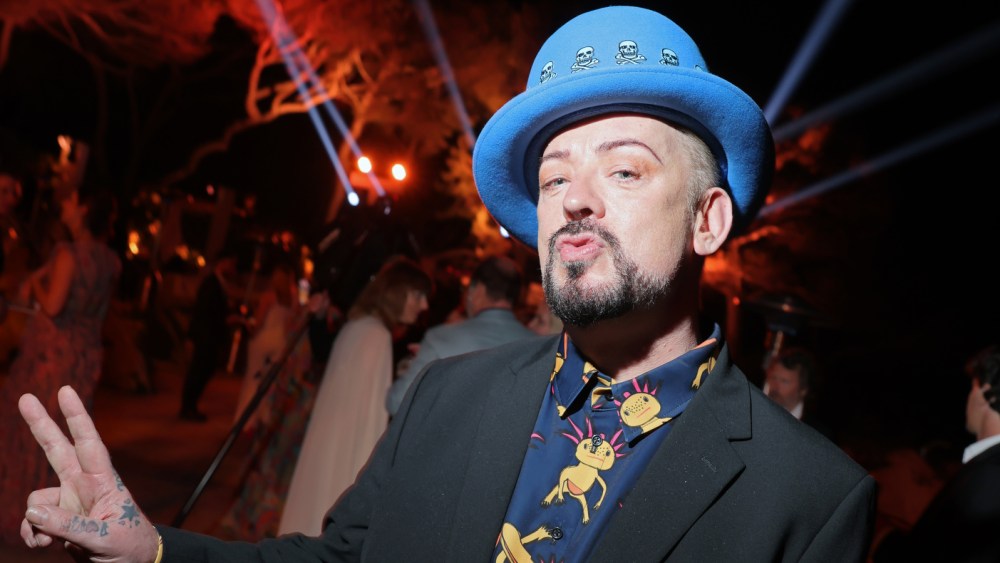
Forty-five years after Boy George upended the music scene with his gender-blurring style, the creative has pruned some of his keepsakes for a Julien’s auction.
Fashion, accessories, photos, art and memorabilia will go under the gavel on July 14 in Los Angeles. The singer, DJ, artist and photographer maximizes his creative output with a new version of the musical “Taboo” being one of his current projects. As the former frontman for the British band Culture Club, Boy George’s insights into identity, culture wars, societal shifts and style cues are sharper than most.
And yes, he has been known to amass all sorts of things, many of which have been stowed away for 10 or 15 years. His longtime friend and collaborator William Baker, a stylist, helped to prune the selections from a storage facility for “Bold Luxury: Boy George Edit.” The sale’s name borrows from the performer’s mantra “Fashion for the Fragile, Style for the Brave.” The onetime Grammy winner, whose given name is George O’Dowd, shared his views about new voyeurism, gender issues, fashion experimentation and more in a recent interview.
“I collect so much stuff that every so often I feel that I have to purge to replace it with more things. It’s sort of a cycle,” he said with a laugh.
The stylist William Baker, whom he has worked with and been friends with for many years, mined the storage facility and splayed out the finds in “a massive warehouse.” The musician said, “It was just the maddest thing ever. One of the funniest things was I have a painting of a friend. That was stuck in the middle of everything like he was watching the whole thing.”
Having not seen many of the garments and other troves for years, the performer said he walked around the “massive” warehouse, where they had been splayed out, remembering their origins and trying things on a few things for a laugh or two. “’Oh great, this one still fits me.’ And having a laugh,” he said.
Pieces from Vivienne Westwood, Jean Paul Gaultier and John Galliano, and Philip Treacy hats, will be up for sale as well as costumes he wore in “Taboo” as Leigh Bowery. Bidders will get a glimpse of Boy George’s flamboyant and androgynous 1980s style. Some of the auction’s proceeds will benefit MusiCares®. An ensemble worn for a 1984 Wembley Arena 1984 “Colour by Numbers” performance is expected to be a top seller, fetching upward of $50,000. Another lived-in look for a 1983 a “Karma Chameleon” performance has a presale estimate of $20,000 to $30,000. He hopes that some of the finds will land in museums or cultural institutions for greater context.
Growing up in southeast London, a multicultural area with strong Jamaican and India communities, instilled in Boy George an interest in other people’s faiths, as well as the ways they dress and think. “As a kid, if I saw a Hare Krishna, I would want to speak to them, not necessarily having to agree with them, but being interested,” he said. “As an older man, I realize that what you wear is only one part of the story whether that’s a punk outfit, a hijab or a priest’s collar. Just because you look like something doesn’t mean that you embody that thing. You have to live it, and be that thing that you are claiming to be.”
While as a young rocker, just the idea of having a career was “horrid” to him. And being a brand? “Ugh, ghastly,” he said. Age has made him realize what he has created, and that has to be enjoyed. “Whereas, when I was younger, there were periods where I didn’t want to be what people thought I was. You reach a point where you’re able to chuck all of it into a big pot — the nostalgia, what you’ve been through and what you are. But I also have a life outside of that as an artist, a DJ and I make fashion.”
Asked what’s driving culture now, he said, “We are in this age of voyeurism and confession. People just feel obliged to spill their guts online about every personal detail of their lives. A couple of years ago it was ‘I’m a DJ,’ ‘I dance,’ ‘I’m this or that.’ But now people are getting into their trauma, which no therapist would ever tell you to do online and then read the comments. Clearly, people don’t deserve that information when you see what they do with it.”
Aware of the obviousness that telling people about his personal business has been a constant in his life, he laughed, “For some reason, before the internet, it didn’t matter. I joke that I used to be the only attention-seeker on the planet, but now you see that everybody’s doing it. There’s this false sense of us knowing more about each other, but we don’t really know about each other. The lives that you present online are not real. They’re jazzed-up versions of what you’re doing.”
At 65, his outlook is that what you think is probably more important than what you wear. “You can change what you wear but you can’t change what you are,” he explained. “Life is kind of a glorious accident, but you can change how you think about it and how you present yourself. But that doesn’t necessarily tell the whole story.”
Although he still plays around with different looks, that is no longer done for other people or their reaction. Not obliged to be dressed up all the time, sweatpants and a beanie often suffice. “It’s funny, when people see you not dressed up and they don’t know who you are, they can be quite rude. Then they suddenly change their tune, when they see who you are,” he said.
Dialing back the clock on his gender-bending start in music, George chalked that up to “youthful belligerence.” Still mystified why anyone would care, he said, “Even now there seems to be this obsession with the word ‘gay’ and ‘trans.’ It’s as if no one has ever heard the words before. I had these conversations 50 years ago. We’re still having these conversations about the way people look and what sexuality they are. It’s mind-blowing.”
Whereas when fame first struck him, if someone didn’t like seeing him on TV, they “had to write a letter, get an envelope, buy a stamp and really give a s–t,” he said. Standing in front of The Black Cap in London on June 8, the performer noticed how some passersby looked hostile, starting at the posters in the pub’s windows of upcoming drag events. “I just think, ‘What difference does it make to you?’”
As somewhat of an exhibitionist, he said he understands the need to have a little hostility to make some noise and leave people a little unsettled. While years ago, some would show their displeasure by ignoring you, “now people feel obliged to shout things at you,” he said.

Boy George performing in 1984.
Disney General Entertainment Con
How he navigates through the world and how others interact with him varies depending if he is dressed up or down. Still touring years after the “Karma Chameleon” hit in 1983, Boy George now relishes the challenge of “a tough audience” and tries to charm them, and never introduce a new song outright as such. They are “hard-wired to object,” he explained. “I’ve even lied about new music and said, ‘Oh, I wrote this for Johnny Cash.’ People were scratching their heads. If you engage people with what you’re singing, it always works,” he said.
Not the fashion clotheshorse that some might think he is, Boy George allowed there was a time when designers were contributing to his stockpile in the 1980s, he said, “You don’t really get free things unless you’re number one or there’s a reason. Designers generally go for someone, who is in the spotlight at that time. If I was getting married tomorrow, I wouldn’t be getting my wedding dress for free,” he said.
As a Gemini, he would rather pay his way and is embarrassed by the idea of asking for something for nothing. “I don’t mind a discount,” he said. “I like the trade-off. I’ve worked with a lot of creative people, but I like to pay my own way.”

An ensemble worn by the Grammy winner for a “Colour by Numbers” performance.
Photo by Robin Clewley/Courtesy Julien’s
The gift of a perfume bottle that once belonged to Elizabeth Taylor is a prized possession. “Liz Taylor is someone, who I loved. I only met her once rather briefly,” he said.
Gaultier is his “best” designer friend. George met Westwood when he was 16 and frequented her shop, [Sex], in London, and continued to buy her clothes in later years. He also DJ’d for Westwood. While there are always exciting things being made in fashion, he probably doesn’t get as excited as others do, due to how much he has seen through the years. “But that applies to everything whether it’s fashion or music. People always say, ‘Oh, this is amazing.’ And I’m like, ‘Well, no, it’s not amazing.’ As I’ve gotten older, I’ve realized the simplicity of a lot of things whether it’s music, fashion, art or any of it. Everything is about context and why you did something.”
In terms of new talent, the artist Tom Zwerver, who is reminiscent of Bowery, is a favorite of Boy George’s. “I messaged him and he had no idea who Leigh was,” he said. “There’s always somebody that I see online that I love, whether it’s a drag queen, media or someone stylish. I really love pop culture.”
Noting how David Bowie spoke in 1999 about how we do not fully know the implications of the internet and how Quentin Crisp recommended 50 years ago that the best way to become a virgin is to go on television, George said, “The iPhone is like a mini-TV. We’re all broadcasting 24/7.”
Having participated in last month’s Eurovision in Venice as a guest artist with the Italian singer Senit, he said there was a real sense of camaraderie among the musicians and the audiences. One objection was the advancement of five countries into the finals without qualifying. Boy George said, “Oh OK, five countries get in without doing anything and everybody else has to compete — weird.”
Regardless, the experience has opened new territories and increased his fan base and his keen to return in a more formal way. Developing a clothing collection is also on his wish list, due partially to his tinkering with clothes and hats in his London studio.

A striped outfit that was sported by the musician for a 1984 Culture Club appearance in Sydney, Australia.
Photo Courtesy
While creative people can be told to stay in their lane, Boy George encouraged pushing against that. “Nostalgia is amazing because it brings all kinds of things into your life, but you have to balance it. It can’t be all nostalgia.”
He declined to talk about how his commercial opportunities have been criticized by Auden Carlsen, who accused him of beating him in 2007. The musician previously denied the beating but was found guilty of false imprisonment in 2008. As for whether his imprisonment changed his outlook for his creative process, he said, “No, not at all.”
With no shortage of ideas and having recently had one of his most successful art shows, he offered, “With everything that is going on in the world, my point of view seems to have a significant context right now. There is a good reaction, because I am highlighting all of the things that are stressing people out.”

Boy George is auctioning some pre-worn items.
Photo Courtesy Julien’s
Always churning out new music and art, he has put out more than 200 tracks in the last two years. With the industry being more of a free-for-all, there are no more rules, he said. “Everything matters. The most important thing is that I have fun all the time. It is a gung-ho mentality whether I am doing something fabulous or at sitting at home watching TV, I am still in a good mood,” Boy George said. “I don’t let the world get on top of me like I once did. Right now, that is nothing short of a miracle. When you look at what’s going on. I wonder if the world has always been mad and we just didn’t know about it. With this new exposure with AI and this new voyeurism, it’s a difficult time to stay sane. Wish me luck [laughs].”
