

Material World is a weekly roundup of innovations and ideas that are reshaping the materials sector. It covers the latest developments in how fashion is designed, engineered, and scaled—from emerging biomaterials and next-generation leathers to engineered fibers and sustainable alternatives.
Recover
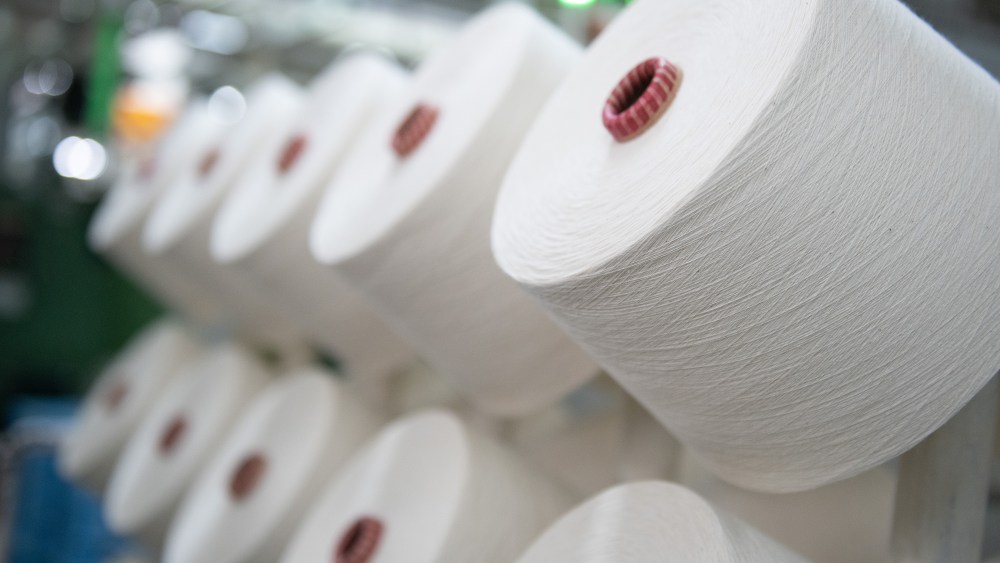
Recycled cotton fiber producer Recover is looking to ease the adoption of circular cotton with the introduction of yarn offerings.
For Recover Yarns, the supplier tapped into its partnerships with more than 150 spinning mills around the globe. These manufacturers used Recover’s fibers in varied blends and yarn types, allowing the yarns to be used for programs such as woven fabrics like denim, knit jersey and performance workwear. The range of offerings also caters to different volume and price point needs. For fabric manufacturers through to brands, this also allows them to easily swap these yarns into production processes.
Before this launch, Recover had existing branded solutions for fibers as well as fabrics and blank garments. With this yarn platform, Recover is extending into an additional manufacturing tier, giving it full supply chain coverage for its branded materials.
“By translating our fiber into ready-to-use yarns, we are making it easier for brands and manufacturers to move from ambition to implementation in their sustainable strategy,” said Anders Sjöblom, CEO of Recover.
Birla Cellulose
Aditya Birla Group’s company Grasim Industries Limited is expanding lyocell production capacity at its Harihar, India plant.
Phase two of the man-made cellulosic fiber (MMCF) company’s plant project will comprise two lines that will each have a capacity of 55,000 tons per year, or 150 tons each day. Representing a 30.9-billion-rupee investment (almost $324 million at current exchange), this next phase reflects the company’s emphasis on eco-friendly fiber production.
“[This investment] is a vote of confidence in the scale and promise of the Indian market, aligns closely with the aspirations of Make in India, and will help position India as a more competitive and resilient force in the global textile industry,” said Kumar Mangalam Birla, chairman of Aditya Birla Group.
This latest expansion is in addition to the first phase of the construction at Harihar on a 55,000 tons-per-year line, which is currently in progress and is slated to be commissioned by the middle of 2027. Birla plans to commission the first line of phase two by 2028 and have the second line up and running by 2030.
Altogether, this will create a capacity to produce almost 210,000 tons of lyocell annually, which Birla says will place it among the top lyocell manufacturers. Once completed, this will also boost Birla’s total man-made cellulosic fiber capacity per year to more than 1 million metric tons, while increasing the share of fibers that fall into its specialty category to 35 percent by 2030. Along with lyocell, which is made using a closed-loop process for resource efficiency, the group’s specialty fiber offerings include modal, recycled fibers and dope-dyed options that are colored while still in liquid form.
“This expansion strengthens our position in the evolving MMCF landscape by scaling a high-value, future-ready fiber segment,” said Vadiraj Kulkarni, business head, Grasim Pulp & Fibre. “By expanding lyocell capacity, we are accelerating the shift towards high-performance fibers with a lower environmental impact. Lyocell enhances our product mix, supports premium applications and aligns with our focus on delivering differentiated, sustainable solutions to global markets.”
Wastewater Dyes
A recent study found an unexpected source for textile dyes: wastewater treatment plants.
Researcher Yuemei Lin, an associate professor at Delft University of Technology in The Netherlands, has extracted a biopolymer from sewage sludge that is similar to melanin, an input commonly used in dye production. Melanin for dyes is often sourced from the ink of cuttlefish, a close relative to squid. However, cuttlefish can only be caught at certain times of the year, and using an animal-based resource comes with ethical considerations. Chemists have been able to create melanin in a lab by oxidizing tyrosine, but it does not match the makeup or performance of naturally derived melanin.
The melanin pulled from the activated sludge—the remnants leftover after wastewater is treated—contains some of the same properties as cuttlefish-sourced melanin, including UV protection and antioxidant activity. It also helps to speed textile drying.
In an article in Water Research, Lin and other researchers noted, “The extracted pigment exhibited high affinity and wash fastness on wool fibers, demonstrating its potential for valorization as a sustainable biobased colorant.”
After successfully using the sludge-sourced melanin to dye wool, Lin partnered with Dutch fashion label Hul le Kes, which created apparel using the pigment. The brand puts an emphasis on eco-friendly design and embraces upcycled and sustainable materials.

Hul le Kes’ garments
“I’m so happy that they’re open to new materials and have gone to great lengths to incorporate it into their fashion designs,” says Lin. “It has resulted in some beautiful garments!”
Both Hul le Kes and the university noted that this is merely a “proof of concept” at this point. In a blog post, the brand wrote, “By connecting different disciplines, knowledge fields and social issues, new ideas and solutions can emerge. Projects like this bring together fashion, science, sustainability and material innovation in a way that allows different sectors to learn from one another and move forward together.”
Barmag and Hitech Automation
Man-made fiber machinery maker Barmag and Hitech Automation Solutions are teaming up to bring automated doffing to texturing systems.
Per Barmag, automating doffing—the process of removing full bobbins of yarn and replacing them in the machine with empty bobbins—supports better productivity and standardizes quality. For instance, Hitech’s Doffmatic ensures that bobbins have the same length of thread.

Through this partnership, Barmag will offer Doffmatic on its new eFK texturing machines while also allowing customers to upgrade its older machines with the automated doffing technology. Both the new machinery and retrofits will use the eFK and Doffmatic brand names.
“Through this exclusive partnership, we combine local market insight, engineering expertise and localized service—offering texturers an automation solution that addresses both efficiency and yarn quality,” said Oliver Lemke, sales director at Barmag.
