

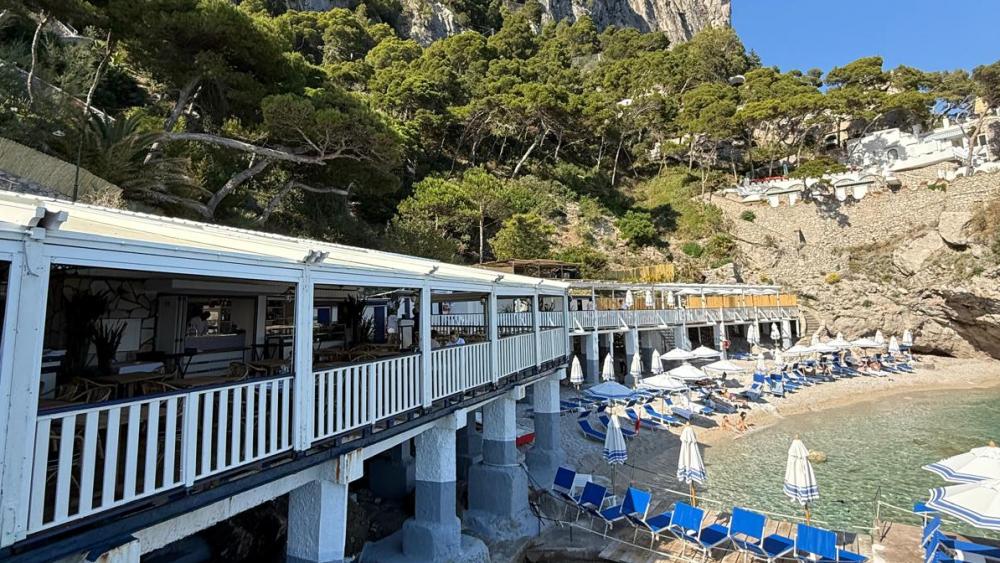
No one needs another reason to visit Capri, which has mesmerized sun and saltwater seekers for millennia, from Roman emperors Augustus and Tiberius to music royalty Beyoncé Knowles-Carter and Jay-Z. Emilio Pucci worked Capri’s sun-kissed colors into his signature swirling patterns while Jackie Onassis spent her 1970s summers there, sunning, shopping and breathing in the pine-filled air.
As of this month, the island has become even more alluring following the relaunch of the historic private beach club Torre Saracena and the opening of a newly refurbished luxury villa, Tenuta Saracena, on the same property in Marina Piccola.
The man behind both is Gabriele Cerrone, the luxury property investor and developer who’s been going to the club with his family since he was a child, and who’s been swooning over one of its specialties, pasta with peas and crushed almonds, for more than 30 years.
In honor of the old days, Cerrone has kept his favorite dish on the menu and added other Neapolitan classics, including pasta with potatoes and mussels. He’s made a big effort to preserve the look and feel of the club, which was founded in 1906 and run until recently by Capri’s Guarracino family.

Gabriele Cerrone
“Those two simple and traditional Neapolitan dishes are not often found at other restaurants in town. But we’ve kept the DNA of the place, offering the food of a typical Neapolitan trattoria,” rather than fancy dishes for tourists, says Cerrone.
“So many Italian, Neapolitan and Caprese families have gone to Torre Saracena over the years — and continue to do so — because they know the food is authentic, and the place is not a tourist trap,” adds Cerrone. Torre Saracena is also the only restaurant on the island that has a live lobster tank where guests can pick a crustacean to go with their linguine.
Cerrone has also kept the decor simple. Unlike some other beach clubs, there is no luxury branding on towels, chairs or in the bathrooms. The decor is blue and white, while the staff’s hand-stitched linen uniforms are from Camiceria Sannino, a tailor located at the foot of Mt. Vesuvius.

An aerial view of Torre Saracena.
“I wanted it be elegant, chic and not too bling-y,” Cerrone says. The club has vintage-style sun loungers, navy blue and white beach umbrellas, wooden decked sun terraces, a pergola, and a pontoon extending over the sea where private yachts can dock.
Tucked between the cliffside and a 16th century tower that was built to keep North African and Ottoman invaders at bay, the club is secluded and remains discreet both in spirit and location.
There are no public beaches, or ports nearby, and the only boats that get close are the yachts anchored in the little bay. Access is by boat and by car. The club is located at the end of a cul-de-sac.
Although Cerrone may spend time at the club with his own family, he has handed over the day-to-day management to a hospitality group led by Antonio Chirico, who built his career at the Capri Palace hotel in the town of Anacapri.

Tenuta Saracena, the private villa located above the club.
Just above the club, Cerrone has also opened Tenuta Saracena, a villa that sits on the biggest piece of property in Marina Piccola and the only home on the island with direct access to the beach. It has a pool, a sweeping view over the sea and accommodates up to eight guests. It’s part of Cerrone’s Faraglioni Collection of luxury villas worldwide, and he says it’s big enough to host events and weddings.
Cerrone, the founder of Trophaeum Asset Management, has rapidly been expanding his hospitality footprint. He likes working with historical sites, making them appealing to the next generation.
Initially his focus was on luxury retail. He helped transform London’s once-sleepy Albemarle Street into the home of brands including Thom Browne, Self-Portrait, the restaurant Isabel and Robin Birley’s private members club Oswald’s.

A view of the Faraglioni from Tenuta Saracena.
He also bought and developed the site of Gucci’s New Bond Street megastore and Alaïa’s London flagship, its only unit outside of Paris. On nearby Grafton Street, Trophaeum transformed the building that once housed the Hong Kong Consulate, making way for the private member’s club Maison Estelle.
Two years ago, Trophaeum acquired an abandoned six-story 1930s building on Via Mascagni in the center of Milan, which had been on the market for more than a decade. It will house the city’s first Soho House club and hotel, which is set to open in two years’ time.
Cerrone says he’s keen on hospitality because post-COVID, “people want to spend more on experiences, instead of buying objects. It’s why hospitality has exploded. That’s why the luxury brands are also expanding into hospitality. There has been an explosion of luxury names — like Dior and Dolce & Gabbana — branding beaches and clubs.”
He adds that Torre Saracena has already had many lucrative offers from the big luxury names to brand the cushions and the chairs, “but we refused because we didn’t want to sell out, or create a Dubai vibe.
“We wanted to maintain the historic, Caprese family DNA of the original place,” he says — peas, potatoes and all.

A view of Torre Saracena beach club.
