

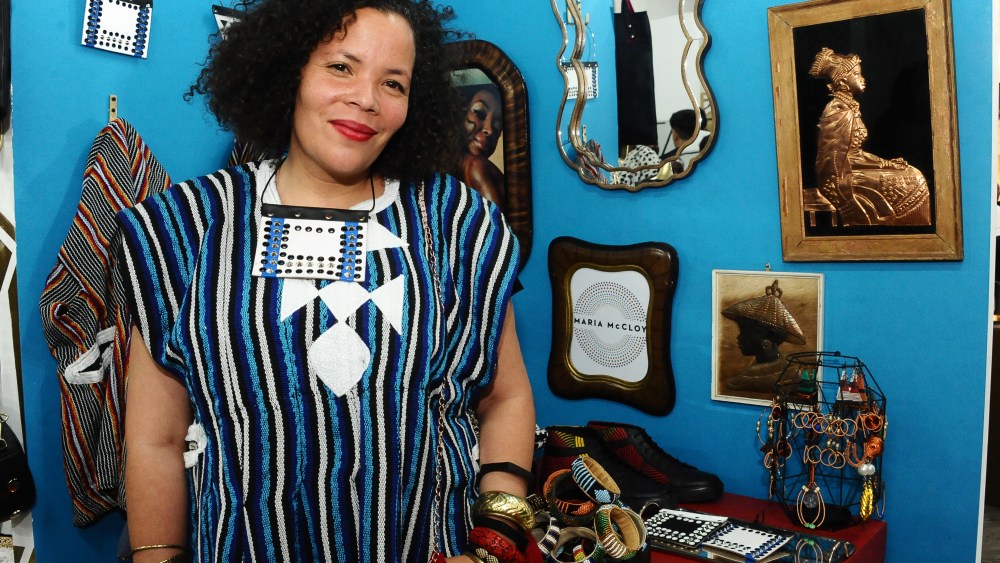
The fashion designer, DJ, writer and publicist Maria McCloy has died at the age of 50.
Services are being planned for McCloy, who passed away Tuesday at Milpark Hospital in Johannesburg following heart failure, according to a statement announcing her death that was released by her family.
Through her years of working in music, fashion and publicity, she was a natural connector, who brought together people and fused art, culture and entertainment into all of her endeavors. Instead of switching tracks, as many professionals do, McCloy forged ahead in multiple fields simultaneously. After attending St Anne’s boarding school in Natal, McCloy studied journalism and politics at Rhodes University, where she earned a bachelor’s degree.
She started her namesake publicity company in 2010 and recent clients included musicians such as Thandiswa, Ladysmith Black Mambazo and Sjava, as well as the Hugh Masekela Heritage Festival. FNB Art Joburg, Nandos in the Mix, KFC Add Hope and the Basha Uhuru Festival. Further back as a publicist at Viacom Africa, she handled outreach for MTV, BET, Comedy Central and Nickelodeon. McCloy also amped up PR for artist Kudzanai Chiurai, musician Toni Braxton, films “Viva Riva” and “Otelo Burning,” as well as stage productions at the Durban Playhouse Company; comedy shows at The Market Theatre, and Babyface’s African tour.
McCloy opened her signature footwear and accessories company in 2007, creating Africa-inspired printed shoes and clutches. She personally sold them at the Workshop Newtown and on Sundays at the Market on Main. Born in the U.K. to an English father and Mosotho mother, McCloy was one of three sisters, who grew up in Lesotho. A self-described “accessories addict,” McCloy once recalled how her mother said that she had loved visiting the markets even as a child.
During the April 2017 edition of South Africa Fashion Week in Johannesburg, McCloy was among local designers who participated in the Woolworths StyleBySA show. Along with Rich Mnisi, Thebe Magugu, AKJP, Sol-Sol, Selfi and Young & Lazy, she showed modern streetwear, footwear and accessories that were inspired by the African continent. In what was then a first for SAFW, the collaborative capsule collection was made available online immediately. That generated “a frenzy of online sales,” Woolworths’ group director of marketing and sustainability Charmaine Huet told WWD at that time.
In the late 1990s, McCloy started what would be years of covering South African music, art, fashion and design. She contributed to outlets such as Rage, The Mail & Guardian, The Star, The Sunday Times, Visi and British Airways Horizons. From 1996 to 2009, she co-owned Black Rage Productions with her cofounders and former college classmates Kutloano Skosana and Addiel Dzinoreva. The trio started the first South African urban culture site, rage.co.za, and South Africa’s first hip-hop label Outrageous Records. The latter was then home to such musicians as Zubz, H20, Pebbles, Proverb and Reason. The trio also worked as script writers at Channel O, when it started and later went on to produce shows as well as ones for Trace TV. McCloy singled out such shows as “Street Journal,” “Soul Sundays” and “Noted,” and documentaries about Busi Mhlongo and the African Hebrew Israelites as their biggest work in television.
In The Mail & Guardian, Lesego Chepape highlighted Wednesday how she was a cultural force. Referring to how McCloy joined Black Rage Productions, Chepape wrote, “Their work mattered because it took black urban life seriously. It understood that fashion, music, parties, slang and aesthetics were not frivolous things but markers of identity and political expression. Maria was central to that language. She understood cool before South Africa knew how to market it back to itself.”
McCloy once described how her international upbringing shaped her style, thanks partially to “pretty dresses” from her English grandmother, cobbled stone street shopping sprees in York with her great-aunt, and “super Seshoeshoe skirts” from her Mosotho grandmother’s village of Mokgwaneng. During U.K. trips, she favored shops that offered DIY earrings with Indian beads. She said, “As much as I liked the high street shops, I loved Oxfam’s second hand wares too.”
Growing up in a house decorated with African sculptures, McCloy liked rummaging through the cupboards for collected cloth. Coming of age amidst children from all over the world and having gorgeous and stylish neighbors influenced her too, McCloy once explained. Friends who were half American and half South African had the latest hip-hop tapes — this was decades before streaming — and copies of Vogue and Elle magazines, as well as sportswear from Benetton and Esprit. Meanwhile, McCloy’s Ugandan and Liberian friends offered “awesome cloths and culture,” she once said.
Grateful for “the outpouring of love, messages of support and condolences,” McCloy’s family said in their statement that “she had a special way of bringing people together and her presence brought comfort, laughter and love to all who knew her.”
McCloy is survived by her mother and her sisters Thandiwe and Natasha. The McCloy family asked for privacy as they grieve and come to terms with their loss. Details about McCloy’s funeral and a memorial service will be announced at a later time.
