

Shares of Birkenstock slipped in pre-market trading after the clog-brand posted second-quarter results reflecting in part the impact from the Middle East war.
The shares at one point were down 6.3 percent to $35.60 in pre-market trading.
“Our business proved very resilient in the fiscal second quarter. Despite the ongoing instability in the Middle East, persistent inflationary pressures, U.S. tariff policy evolving unfavorably for us and continued [foreign exchange] headwinds, we delivered constant currency revenue growth of over 14 percent,” Birkenstock’s CEO Oliver Reichert said. “This performance was well within our near-term and long-term target of 13 to 15 percent.”
Reichert added that the company has a “long runway for growth ahead,” while noting the brand’s globally accessible, relevant and democratized brand experience that serves a broad consumer base.
“In an overall challenging environment, we continue to see strong opportunities,” he said. The Asia Pacific market is growing at twice the pace of the other businesses, Reichert said, adding that the brand is accelerating the pace of company owned retail store openings. In addition, he said the close-toe share of business “continues to expand.”
William Blair’s Sharon Zackfia said that the slight miss in the second quarter was due to the Middle East war. The analyst said the brand saw a $6 million war-related revenue impact in the EMEA (Europe, Middle East and Africa) region, with about half a direct impact where Birkenstock was unable to complete some deliveries to the Middle East, and the other half from muted consumer sentiment in Europe on higher energy costs and inflation due to the was.
For the period ended March 31, second quarter net income fell 22.1 percent to 81.9 million euros, or 45 euros a diluted share, from 105.1 million euros, or 56 euros. Revenue rose 7.7 percent to 618.3 million euros from 573.3 million euros.
The consensus estimate for revenues in the second quarter was 620.3 million euros.
By region, the brand saw revenue growth across all segments: up 4 percent in the Americas, up 10 percent in EMEA, and up 22 percent in APAC (Asia Pacific). The company also said B2B revenue growth was up 9 percent, while DTC (direct-to-consumer) revenue was up 4 percent.
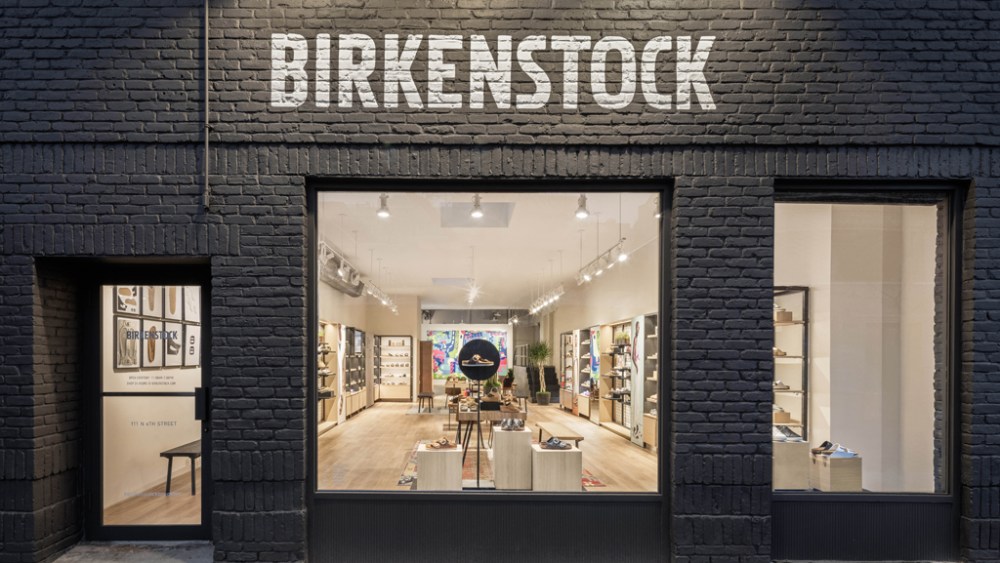
The company opened five new stores during the quarter, bringing the total number of company-owned doors to 111 at the end of the second quarter. By region, Birkenstock opened two retail stores in the Americas, one store in EMEA, and two locations in APAC. It now operates a total of 17 locations in the Americas, 46 in EMEA, and 48 in APAC.
For the quarter, gross profit margin was down 380 basis points to 53.9 percent due to unfavorable currency translation, incremental U.S. tariffs and channel mix, all partially offset by sales price adjustments and improved capacity absorption. Birkenstock said the decline was also driven in part by the impact of 70 basis points from the mark-up to cost of sales connected with the acquisition of the long-standing distributor Birkenstock Australia Pty. Ltd., which closed on Oct. 23, 2025.
In addition, the adjusted gross profit margin of 54.6 percent was down 310 basis points due in part to unfavorable currency translation, incremental tariffs and channel mix, and partially offset by sales price adjustments and improved capacity absorption.
For the six months, net income rose 5.7 percent to 132.4 million euros, or 72 euros a diluted share, versus 125.2 million euros, or 67 euros. Revenue rose nearly 9.0 percent to 1.02 billion from 936.0 million euros.
For Fiscal 2026, the company confirmed earlier guidance of 13 percent to 15 percent revenue growth in constant currency and adjusted gross profit margin of 57.0 percent to 57.5 percent. The company said it expects capital expenditures in the range of 110 million euros to 130 millon euros.
Earlier this year, Birkenstock and Danielle Frankel collaborated on a bridal footwear collection, and then the brand followed up with a new tie-up with Etro, with the duo updating the German footwear brand’s signature Boston clog.
