

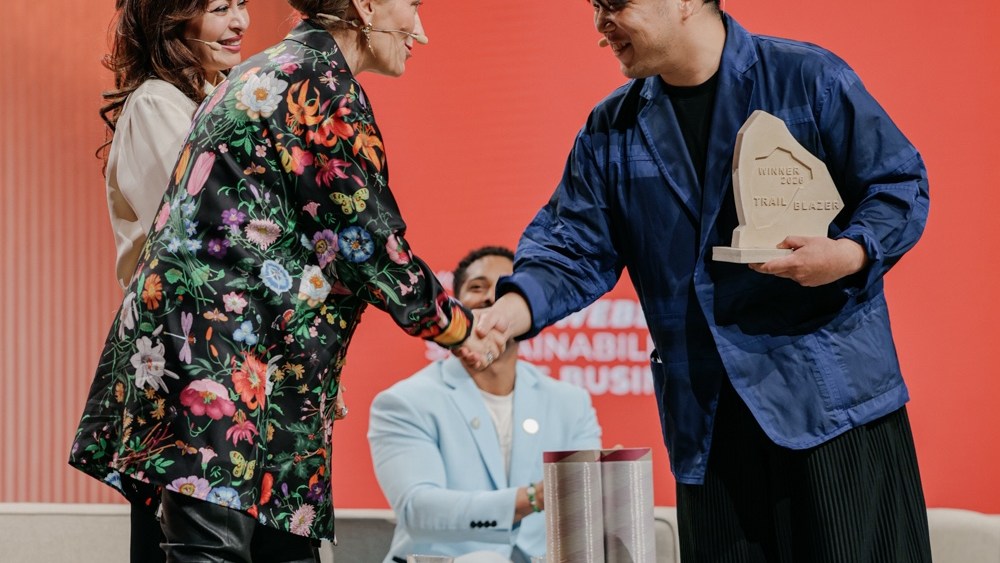
For Kazuya Kawasaki, CEO of Synflux, keeping textile waste out of landfills begins at the design stage.
At least 30 percent of material is lost on the cutting room floor, he said at the Global Fashion Summit in Copenhagen on Thursday. His solution: Using a combination of machine learning and 3D simulation to generate and test hundreds, even thousands, of cutting pattern variations in a few minutes.
“The result is up to 66 percent less waste with no changes to the design or quality,” he said.
None of this is simply theoretical, Kawasaki noted. Synflux ran a pilot with The North Face, halving the amount of waste produced by one of the outerwear brand’s bestselling jackets. It’s been steadily expanding upstream, working with OEM manufacturers in its native Japan and elsewhere in Asia.
“We see artificial intelligence as the key to transforming sustainability in fashion,” he said. “When supply chain data is connected and AI-driven, something powerful happens: You can predict risk before it becomes a problem. You can build circular systems that are smarter and more efficient. You can make better decisions.”
Kawasaki’s pitch to Global Fashion Agenda and PDS Ventures’ Trailblazer Programme—now in its third year—worked. Synflux is poised to receive a $200,000 infusion from the $50 million venture capital fund pending final due diligence and committee approval. The award includes strategic and operational support from PDS Group, the India-headquartered sourcing platform underwriting the fund, alongside development and commercialization assistance from PDS subsidiary Positive Materials.
Choosing between Synflux and the other two finalists—MacroCycle, which recycles any kind of plastic waste into virgin-grade PET, and Fibe, which produces clothing from potato harvest byproducts—wasn’t easy, admitted Marie-Claire Daveu, chief sustainability and institutional affairs officer at Kering and chair of the selection committee.
Still, it was Synflux’s big-picture approach that ultimately tipped the scales.
“It’s about scalability,” Daveu said. “We can do it for the entire textile industry, so we can hope to be really impactful quite quickly.”
Innovation is a core pillar at Kering, she said, adding that breakthrough—even disruptive— technologies are essential for the luxury conglomerate to deliver on its ambitious commitments regarding carbon, water and biodiversity.
“That’s why we focus on three layers,” Daveu said. “First, the next generation of materials; second, innovation around processes—it can be for tanneries, dyeing or end-of-life; and third, traceability and transparency. Because if you cannot say where your raw materials are coming from, you cannot do anything.”
Kering’s own Material Innovation Lab, founded in 2013, now features a library of more than 8,000 sustainable fabrics. In 2019, the Gucci and Saint Laurent owner launched the Kering Generation Award to scout innovative talent worldwide—an initiative that has since expanded to include a dedicated jewelry edition.
“There is no future without innovation in sustainability,” Daveu added. “It’s a way to anticipate regulations. It’s a way to anticipate market shifts. It’s a way to be as efficient as possible in your production—to use the right quantity of materials. It’s about how we can create new business…because we are not only doing philanthropy: We have to run a business; we have to earn money.”
Faiza Seth, co-founder of PDS Group and another member of the selection committee, agreed that scalability is what allows a good idea to thrive—particularly when approached proactively rather than reactively. While capital is a critical catalyst, it is rarely a stand-alone solution.
“That’s where PDS Ventures comes in—with also Kering and GFA—to put all of these innovators on a platform where they can be seen and they’re visible to a community of people who are forward thinking,” she said. “They want future-readiness. So we’ll use that ecosystem to help the trailblazers and help these innovators get that scale they need.”
Innovation frequently faces a “chicken and egg” dilemma, Seth said. Startups require credibility to secure contracts, but they can’t build credibility without a proven track record of revenue.
Beyond capital, a company’s commercial viability depends on its ability to integrate into existing supply chains without demanding an overnight industry overhaul.
“It needs to be easy for everyone in the industry to understand and easy to implement,” Seth said.
For Kawasaki’s part, Synflux is prepared to rise to the challenge of the summit’s theme—Building Resilient Futures—even though the goal feels increasingly aspirational amid the groundswell of global instability.
“Costs are rising, the supply chain is under pressure and AI is changing everything,” he said. “But Synflux is ready for the moment, ready to help manage production, ready to address cost pressures and ready to contribute to a resilient future.”
