

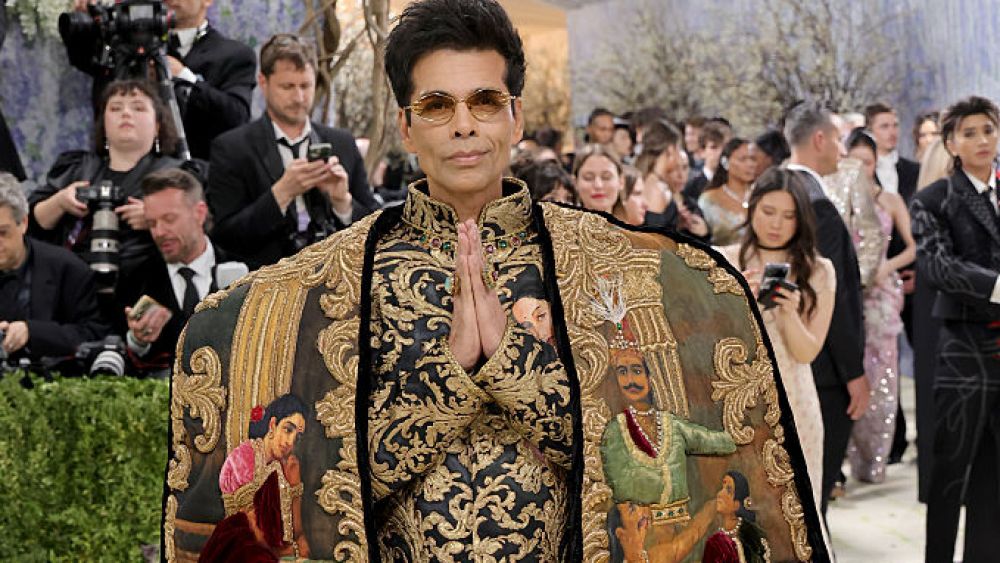
“India almost got the assignment better than any other,” Karan Johar mused to WWD the day after his Met Gala debut. The Bollywood filmmaker spent Monday evening on the Metropolitan Museum’s steps in a dramatic Manish Malhotra creation drawn from Indian classical paintings. Also on the red carpet: a reigning maharaja and three women from India’s biggest business families. The Indian contingent’s looks read as a direct celebration of craft and art — ones that read “Fashion Is Art” most literally.
If Johar gave the night its verdict, his designer gave it its thesis. “When I heard fashion is art, the first word that came to my mind was artisans,” Manish Malhotra told WWD. “It was the right place to give credit to the people who work behind all of it.” It was the line the rest of the Indian contingent’s looks would also argue.

Designer Manish Malhotra wearing a cape featuring sculptural figurines of artisans he has worked with for decades.
Behind Malhotra’s look for Johar was a 32-year history of working together. In 1994, Johar’s first job in the film industry was as Malhotra’s costume assistant on what became one of Bollywood’s most iconic films, “Dilwale Dulhania Le Jayenge.” Johar, now one of the Hindi film industry’s most successful filmmakers, said the moment was full circle.
“When I was invited to the Met there was no other designer I would have turned to,” he said.
Drawing from Indian painter Ravi Raj Varma’s work, Malhotra combined vintage zardozi, three-dimensional embroidery and hand-painted gold work in a dramatic cape that made a powerful statement on the Met carpet.
“I didn’t want to arrive here trying to explain India,” Johar told WWD. “I wanted to arrive feeling like myself, and that automatically brings everything I come from with it.”
Asked what he meant by “explain India,” he was more direct. “There’s an exotification of our deeply rooted culture and heritage that I have a problem with,” he said. “If you’re on a red carpet of this scale and you don’t know who’s walking it and what they represent, you’ve shortchanged yourself. If you don’t know our culture, you haven’t really lived a life.”
It was a direct, if unnamed, reference to last year’s Met, where superstar Shah Rukh Khan and singer Diljit Dosanjh generated some of the carpet’s highest earned-media values but received only fragmentary identification from American press. Indian guests won the engagement but Western media captions largely lost them.
For two decades, India’s Met presence had been overwhelmingly Bollywood leading ladies, from Aishwarya Rai to crossover superstar Priyanka Chopra Jonas. This year, for the first time, the Indian guests on the steps were not primarily film stars.

Maharaja Sawai Padmanabh Singh aka “Pacho” of Jaipur and his sister, Princess Gauravi Kumari, both wearing Prabal Gurung
Courtesy photos
Maharaja Sawai Padmanabh Singh of Jaipur, known as Pacho to his friends, and Princess Gauravi Kumari, his sister, made their Met debuts in Prabal Gurung. Padmanabh, 27, has spent the better part of a decade as one of fashion’s most-watched young royals — modeling for Dolce & Gabbana, sitting front row at couture week in Paris, and a fixture on international best-dressed lists. His sister’s chiffon-and-pearls look drew from their grandmother Maharani Gayatri Devi, dubbed one of the world’s most beautiful women by legendary Vogue photographer Cecil Beaton in 1946. His own outfit was anchored on a traditional Jaipur Phulghar coat finished with aari and zardozi across more than 600 craft hours.

Isha Ambani wearing Gaurav Gupta and carrying a mango sculptural piece from Subodh Gupta
Getty Images for The Met Museum/
Isha Ambani returned in custom Gaurav Gupta woven with pure gold by artisans who spent more than 1,200 hours creating it. She also carried a bronze mango sculpture by artist Subodh Gupta as a handbag. Ananya Birla, director of the Aditya Birla Group, made her debut in a stainless-steel mask, also by Gupta — making him the only artist with his actual artwork on two Met looks Monday.

Ananya Birla wearing a mask by artist Subodh Gupta made of Indian stainless steel utensils.
Diya Mehta Jatia, an Indian businesswoman and tastemaker, wore Mayyur Girotra — the Delhi based designer’s first Met commission. The piece layered Bengal’s Shola handcraft over a gold-and-silver Kanjivaram silk base. “Shola is an endangered craft that very few people are doing,” Girotra told WWD. The designer works with clusters of artisans across India to help revive dying arts.

Diya Mehta Jatia in custom Mayyur Girotra at the 2026 Met Gala. The baroque silhouette layers Bengal’s near-extinct Shola work over a real-gold-and-silver Kanjivaram base from Kanchipuram.
If the night had a designer of record, it was Malhotra. In his 35th year in the business, he created four custom looks for Monday night, including actress Camilla Mendes, and Dwayne Johnson, who wore Malhotra’s Colombian-emerald brooch from the designer’s high jewelry line on a Thom Browne tailcoat, the kind of cross-house placement typically reserved for European jewelry maisons.

Dwayne Wade wearing a brooch from Manish Malhotra High Jewelry.
It was, in his telling, the latest stage of a two-year expansion into Hollywood that has included work with Jennifer Lopez, Rihanna and Zayn Malik. “It’s a very unusual story for a costume designer to start a mainstream fashion business and make it into a brand,” Malhotra said. But his brand of costume for Bollywood films has translated well on global red carpets. Mendes’ look last night, while not appearing as obviously Indian as Malhotra’s design for philanthropist Sudha Reddy, the inspiration was very rooted in Indian art.

Camilla Mendes’ Manish Malhotra mahogany gown drew from Indian arist Amrita Sher-Gil’s distinctive palette, carrying the warmth of her oil pantings.
The jewels worn by the Indian contingent marked another departure from red-carpet convention. Where most Met guests arrive in pieces lent by Cartier, Bulgari or Tiffany, the Indian principals wore privately owned heirlooms. Reddy’s necklace alone, anchored by the 550-carat Queen of Merelani tanzanite from Tanzania, was valued at more than $15 million. Ambani’s sari blouse was set with diamonds from her family’s collection. On a carpet whose luxury economy is built on borrowed jewelry, India brought its own.

Sudha Reddy in Manish Malhotra
For Johar, the global mood had shifted. “When I was at Cannes last year, for the first time in many decades, no one said ‘oh my god, you’re from India,’” Johar said. “We’re not just song and dance. Bollywood is not a rhyme of another cinema. We are a reason.”
The 2026 Met drew critique for the optics of its wealth — a billionaire-heavy guest list in a year when much of the world is feeling pinched. India’s contingent was no less moneyed, but its looks perhaps rang differently: garments celebrating the hands and hours behind it, artisan credited. The 2026 Met handed the country its strongest and broadest cast yet: cinema, royalty, industry. The soft power was in the surfaces.
